TARGO and TARGO-Net: Benchmarking Target-driven Object Grasping under Occlusions

Accepted at IJCV 2026
1University of Science and Technology of China, 2Technical University of Munich, 3CFCS, School of CS, Peking University,
4University of Oxford, 5Munich Center for Machine Learning (MCML)
*Indicates Equal Contribution

Directly grasping a target object from a single RGB-D view, even when it is heavily occluded.

Overview

In real-world manipulation, the target object is often partially hidden by nearby objects. Rather than avoiding this challenge through next-best-view planning or occluder removal, TARGO studies direct target-driven grasping from a single RGB-D observation.

This project introduces an occlusion-aware benchmark for target-driven object grasping and a model named TARGO-Net. TARGO-Net segments the visible target, completes its missing geometry, reasons jointly over the completed target and the full cluttered scene, and predicts collision-free grasps that remain robust under high visual occlusion.

Occlusion-Aware Benchmark

Grasping performance is evaluated as target visibility decreases.

Single-Scene Data Augmentation

Training includes occlusion-induced failed grasps from single scenes.

Balanced Offline Test Set

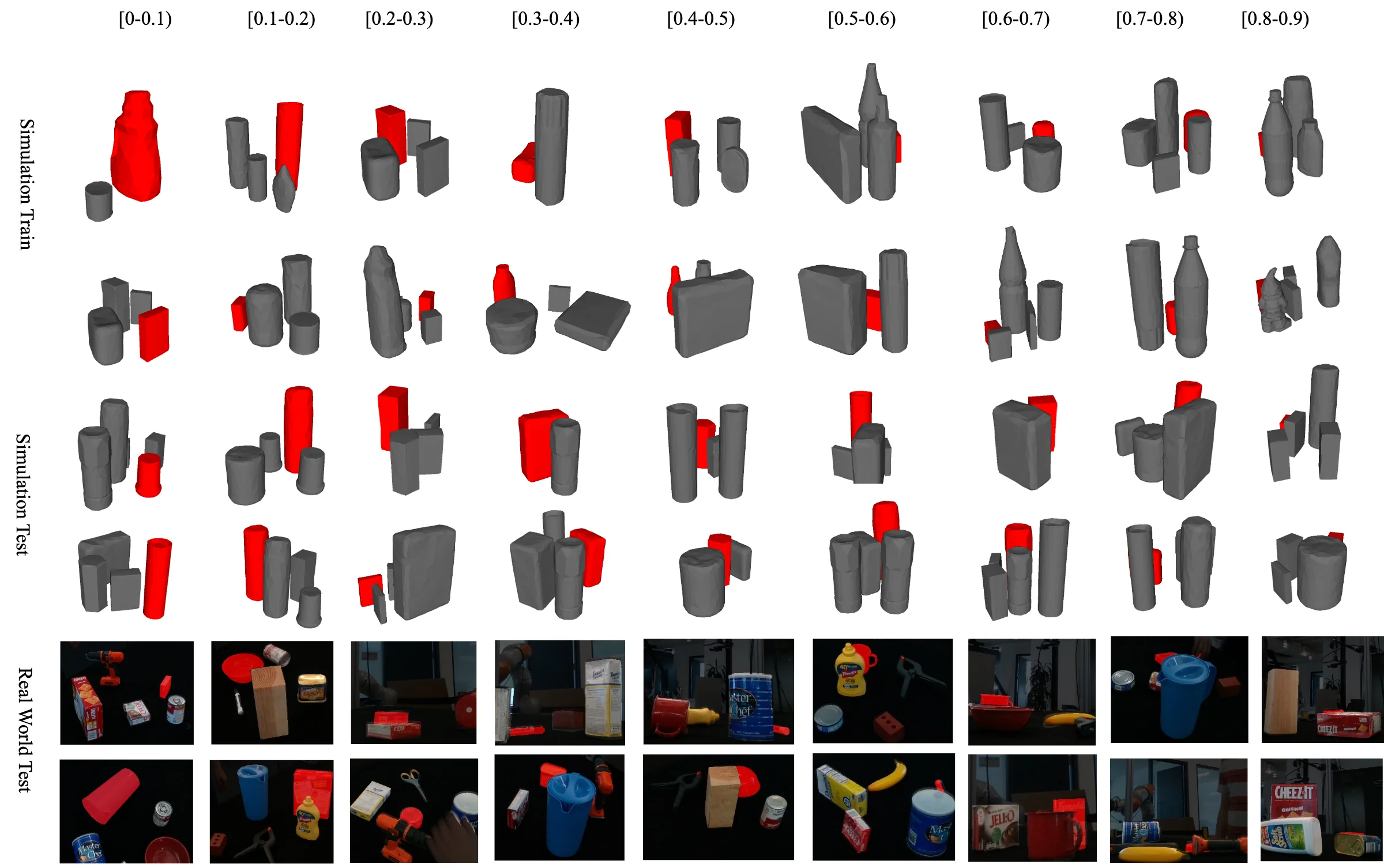
Each occlusion level from 0 to 0.9 contains 1,000 scenes.

TARGO-Net Target-Scene Transformer

Completed target geometry and scene context are fused with cross attention.

TARGO Dataset

TARGO dataset overview
TARGO-Synthetic training data, occlusion-balanced synthetic test scenes, and TARGO-Real scenes.

TARGO-Synthetic is constructed using VGN objects in PyBullet. Random placement naturally produces many low-occlusion scenes, which are useful for training but insufficient for stress-testing occlusion robustness.

To avoid overestimating performance on easy scenes, the benchmark includes a balanced test set with 1,000 scenes for every occlusion level from 0 to 0.9. TARGO-Real further evaluates transfer to real-world cluttered grasping with a Panda arm setup.
Single Scene & Visual Occlusion Level

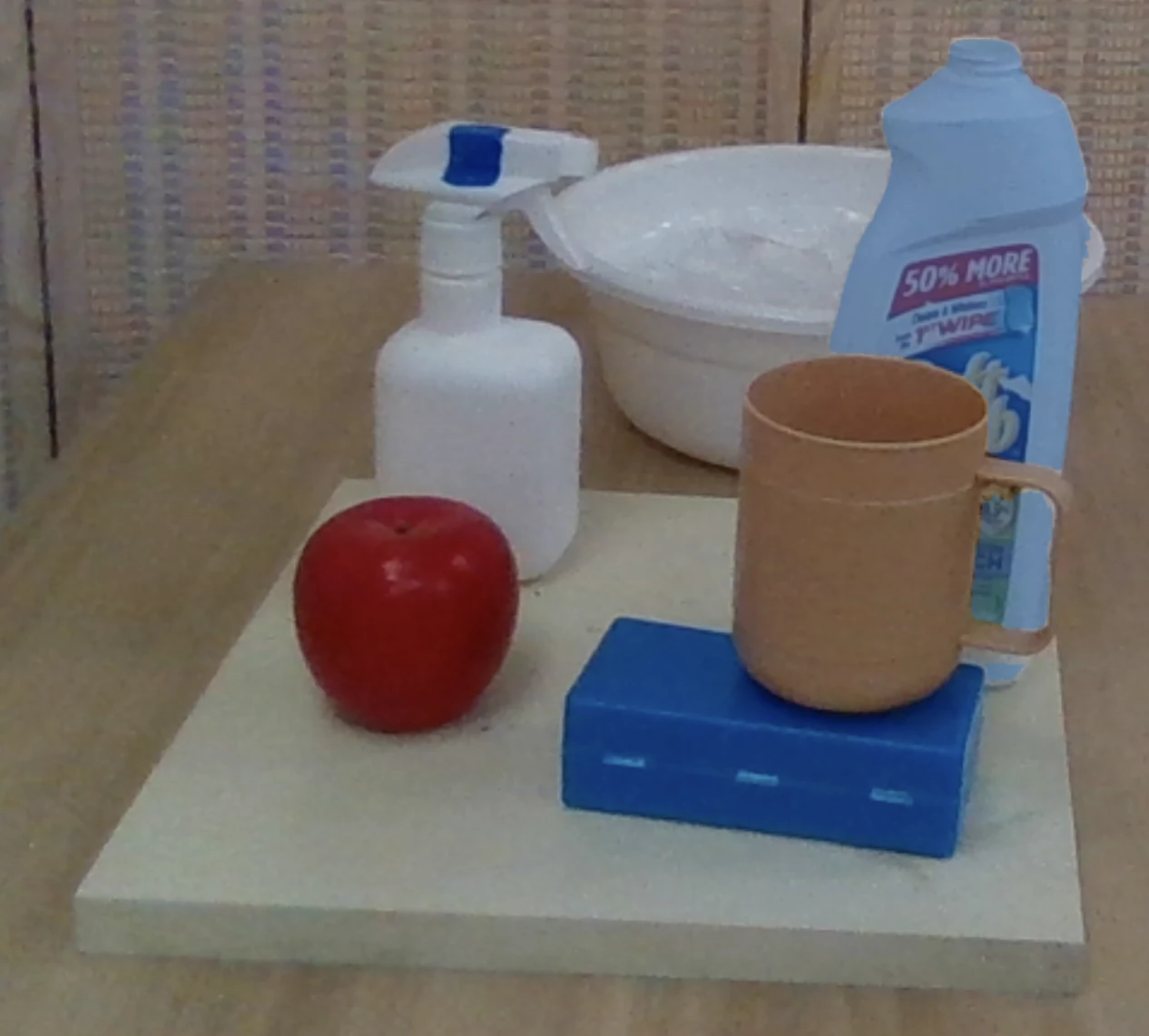
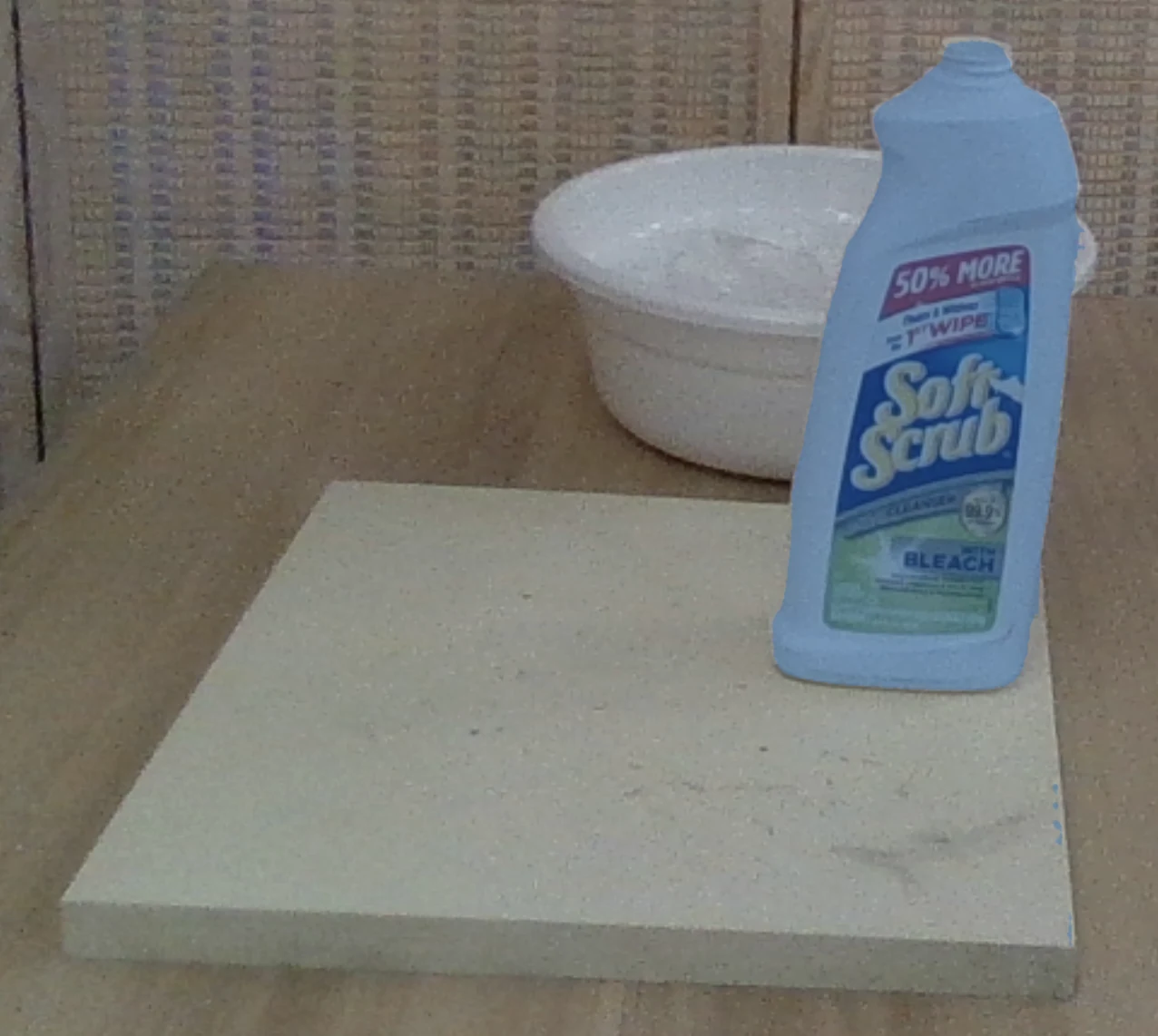
For each cluttered scene, a target object is selected to induce a corresponding single scene, where the same target is observed from the same camera pose but all occluders are removed. The visual occlusion level is computed by comparing visible target pixels in the cluttered scene with target pixels in the single scene.

Cluttered Scene
Cluttered scene
Single Scene
Single scene

For example, if 13973 target pixels are visible in the cluttered scene and 25015 pixels are visible in the single scene, the visual occlusion level is 1 - 13973 / 25015 = 0.441.

Single Scene Data Augmentation

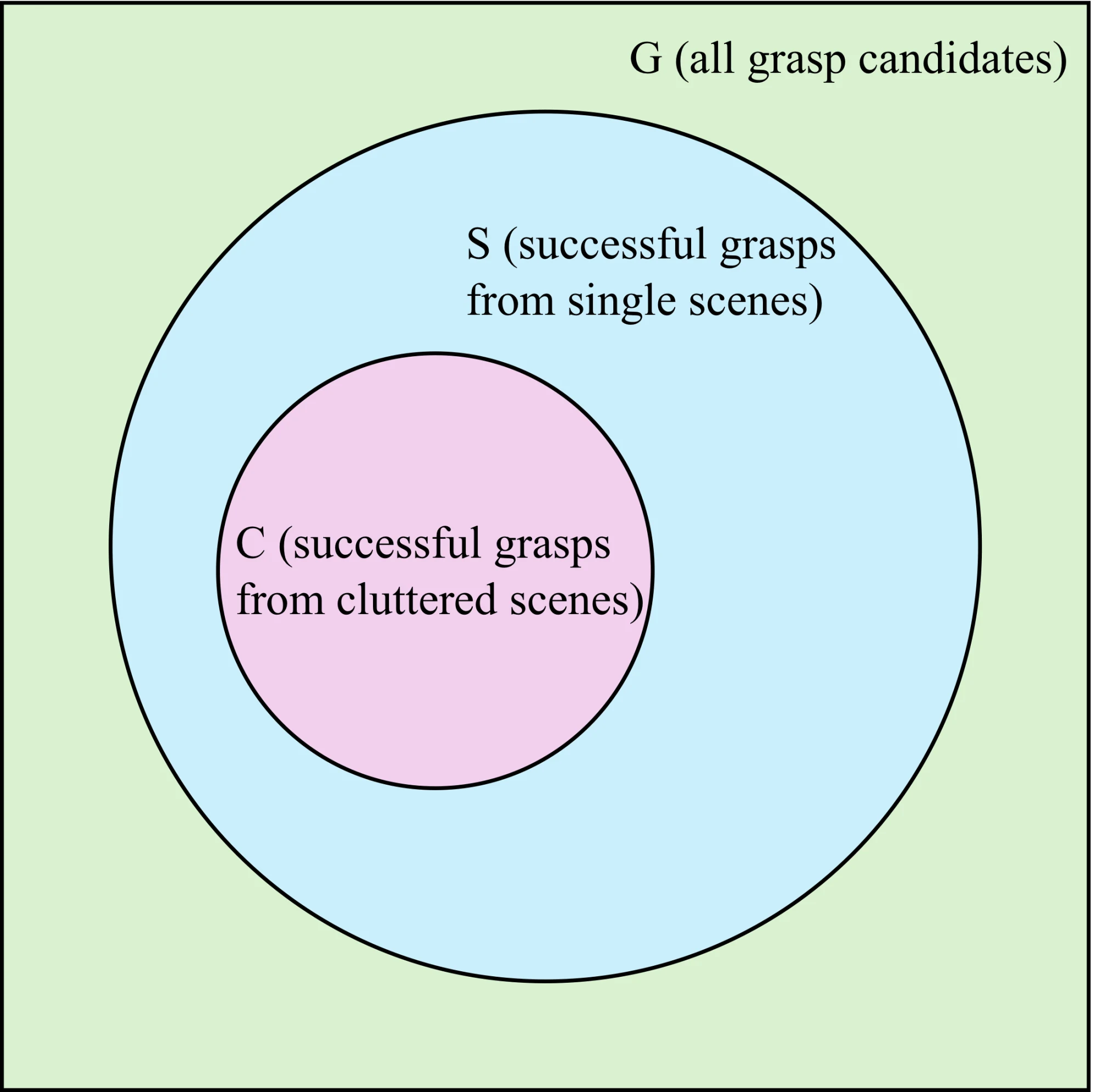
C S G
Venn diagram of successful grasps in single and cluttered scenes
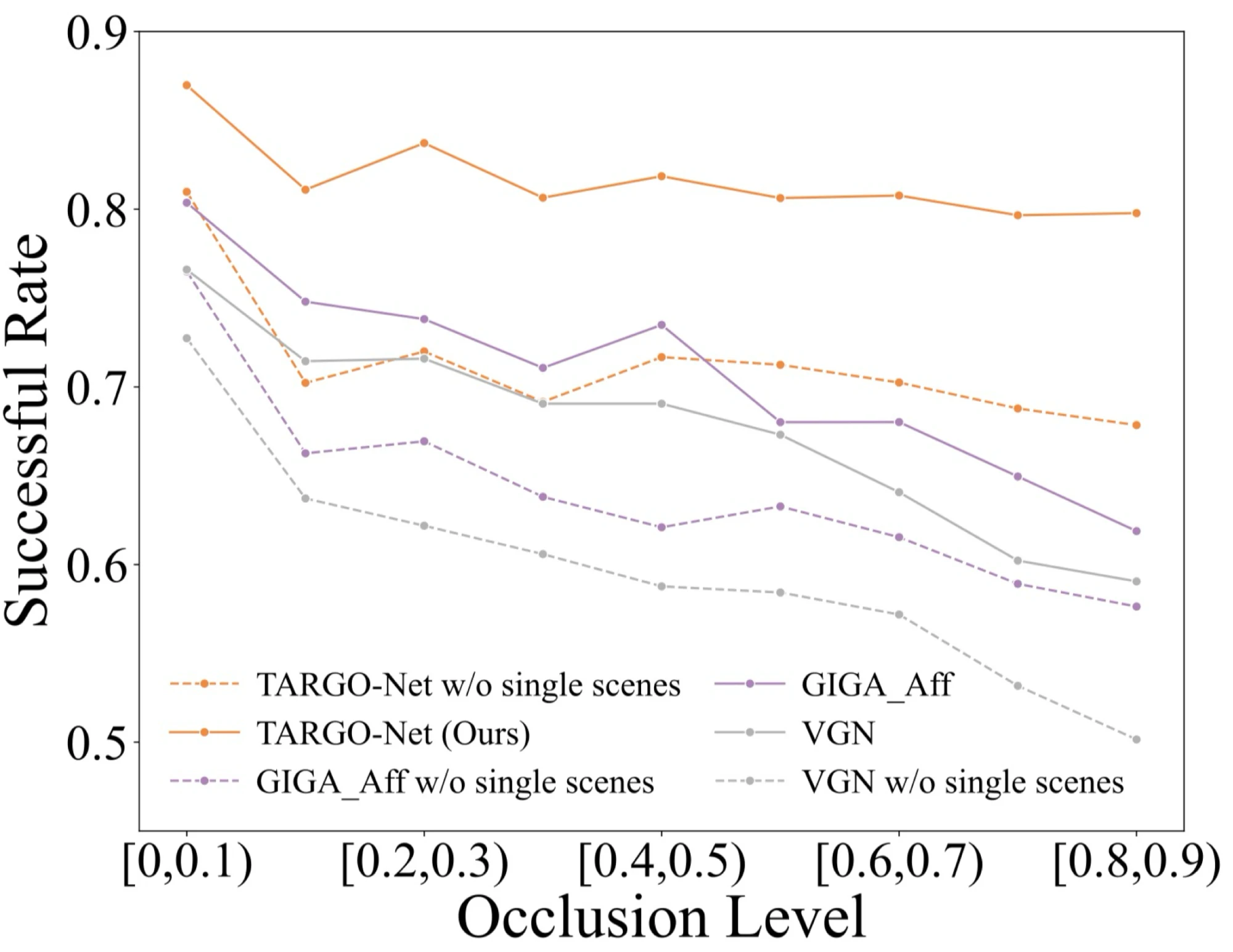
Single-scene data augmentation results across occlusion levels

Let C denote successful grasps in the cluttered scene and S denote successful grasps in the corresponding single scene. The set S \ C captures grasps that are feasible for the isolated target but fail once occluders are present.

Training with these occlusion-induced failures teaches the model how surrounding objects constrain feasible grasps, improving baseline methods by at least 5% and TARGO-Net by about 10%.

Benchmark Findings

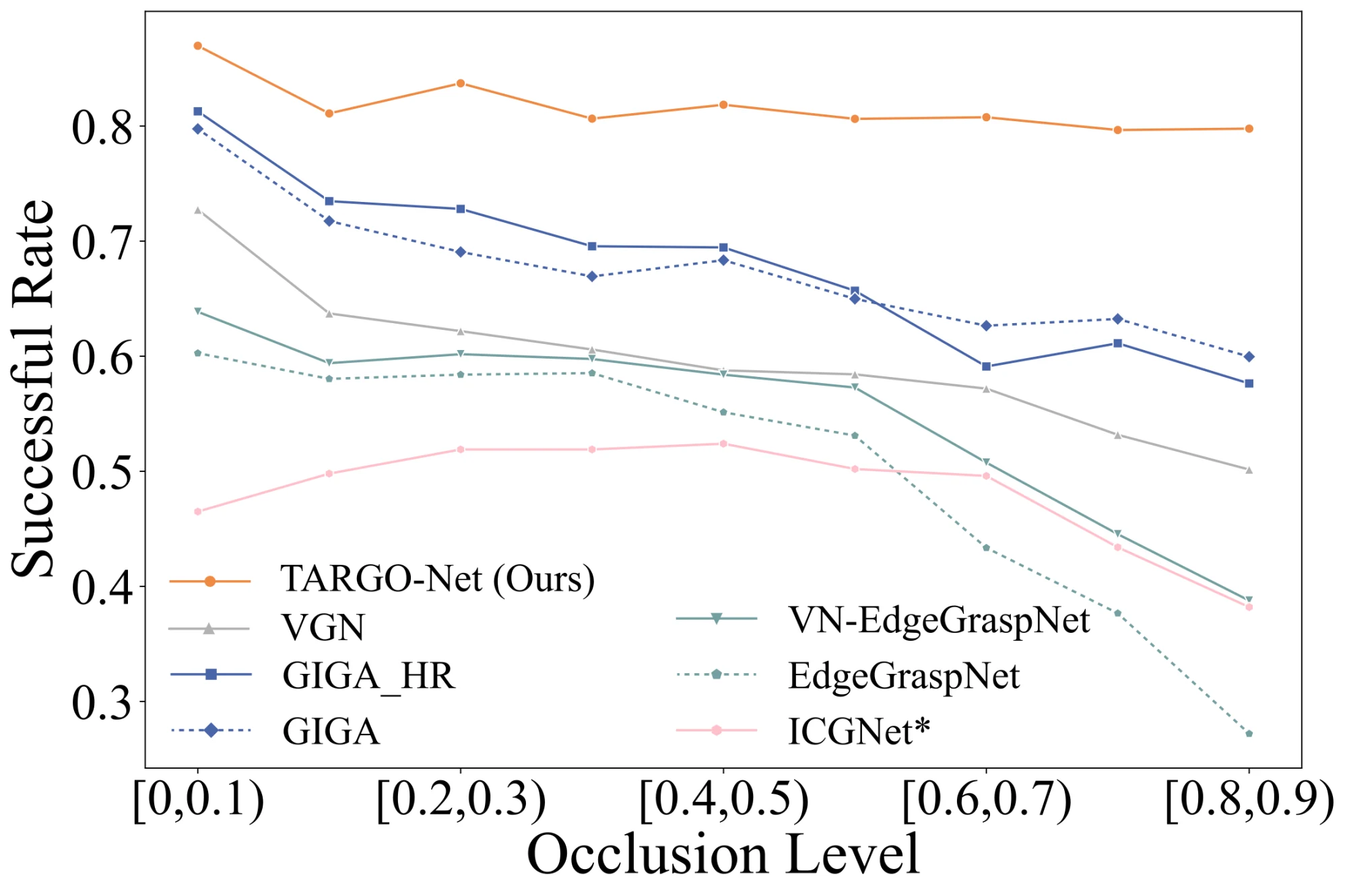
Synthetic benchmark results across occlusion levels
Grasp success rate decreases as visual occlusion increases. TARGO-Net remains the most stable under high occlusion.

On the balanced synthetic test set, existing state-of-the-art methods such as VGN, GIGA, EdgeGraspNet, and ICGNet show a clear performance drop as occlusion increases. TARGO-Net drops by only about 7% even at extreme occlusion levels, while other methods drop by roughly 20% or more.

TARGO-Net

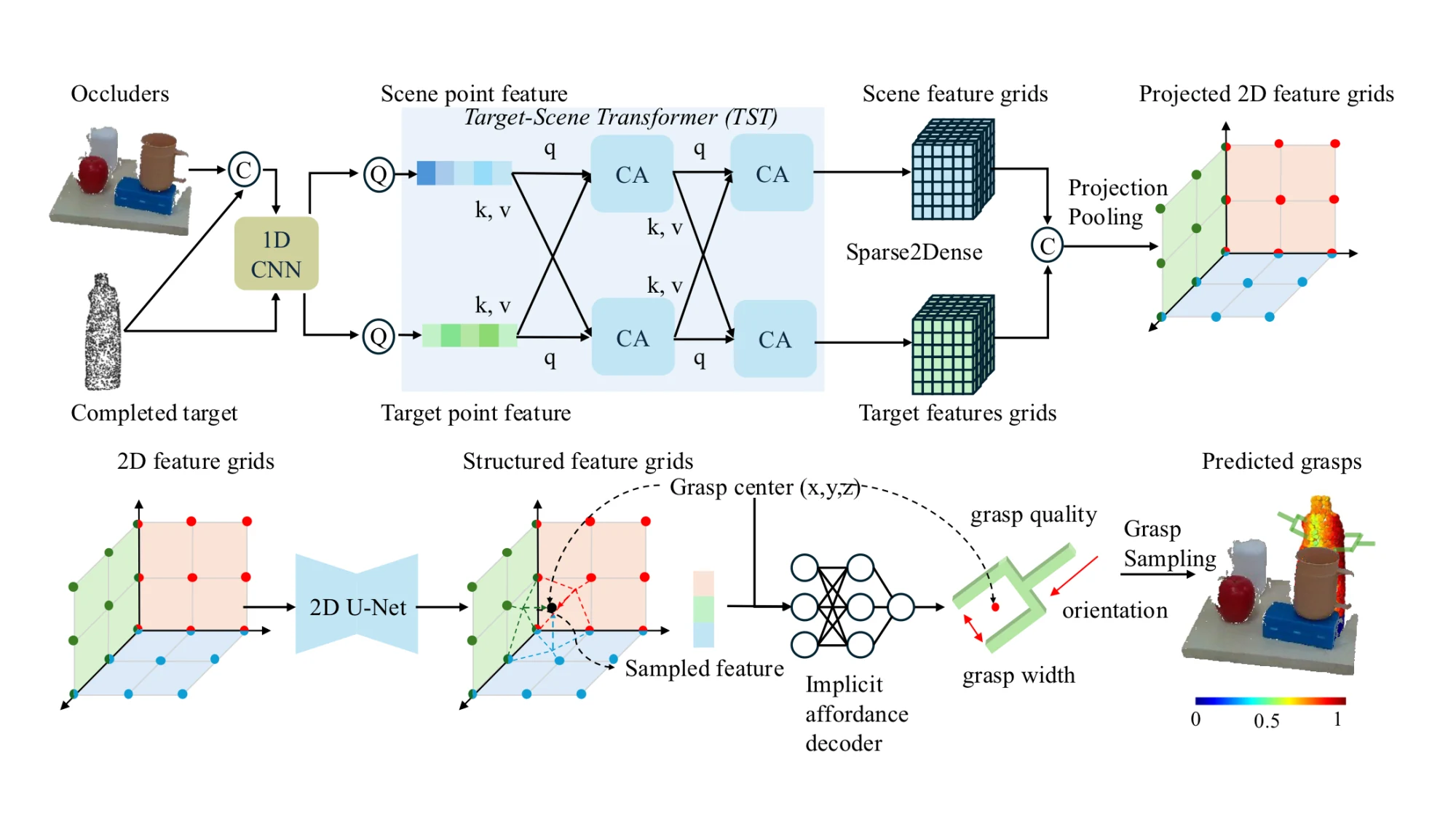
TARGO-Net architecture
TARGO-Net completes the visible target, fuses target and scene features with the Target-Scene Transformer, and predicts grasp quality, orientation, and gripper width.

Given an RGB-D input, TARGO-Net first segments the visible target and completes its missing geometry. Scene and completed target point features are encoded with a 1D CNN, then fused by the Target-Scene Transformer (TST) with cross attention.

The fused sparse 3D features are converted to dense grids, projected into 2D feature planes, and refined by a 2D U-Net. An implicit affordance decoder predicts grasp quality, orientation, and gripper width for each grasp center, after which the highest-quality collision-free grasp is selected.

Real-world Experiments

In real-world Panda arm experiments, the performance gap becomes even clearer. Baselines such as GIGA decrease by about 40% from easy to hard scenes, while TARGO-Net remains robust with only about a 13% drop.

TARGO-Synthetic Dataset Contents

The compressed archive file contains:

  • mesh_pose_dict/: object mesh paths and object poses for each scene.
  • scenes/: depth images, target masks, TSDF grids, target points, and occlusion levels.
  • grasps.csv: scene IDs, 6DoF grasp poses, grasp widths, and grasp labels.